Showing posts with label language. Show all posts

Tuesday, August 17, 2010

Oh CUTE!

English is an interesting language.

Well, some people seem to think so anyway. And, I guess I fall into the category of "some people". But something that makes English so interesting is that it is a living language. It lives in the same way Frankenstein's monster does/did/I don't know if he's still alive. I say that because of how much it is driven by popular culture, vernacular, and is in essence a flowing amalgam of bits and pieces from many other languages and cultures beyond merely those of the British isles and places that were at once part of the British Empire. Ok, let's get to the point.

The word CUTE has become in a way, it's own sub-language. It's versatility is frighteningly unoriginal:

Here is the way in which it was at one point, and may sometimes still be used:

- That baby/puppy/halloween outfit* is CUTE.

*all terms can also be exchanged for butterfly wallpaper, floral arrangements, kittens, etc.


However, here is the way in which it is now used:

- He's CUTE. - (in reference to a boy/man - who should in fact never be considered cute, unless he looks like a puppy holding a floral arrangement while wearing a children's halloween costume - and in that case I believe the correct terminology would be FREAK. A man/boy used to be called attractive, handsome, good-looking, etc., but now, he has unfortunately been relegated to puppy status. If that were all, then no worries, but cute is a universal coverall as we shall see)

- That's so CUTE! - (when referring to any object that has a favorable color scheme or design, when one could just say, "I love those colors, such and such compliments the other, and/or that is a clever or creative way to use yellow and blue/pink and mint green/etc. and etc.)

- Oh what a CUTE sign! - (When the sign is actually not cute at all, bearing no resemblance to a newborn baby, puppy, and containing nothing resembling a kitten with a bib and pacifier. Most often the sign contains a clever turn of phrase, is witty, or is just cleverly being offensive while also subtly attempting to be innocuous)

- Oh CUTE! - (When referring to anything, ever, for any reason at all)

So there you have it. Is there a remedy for this generic way of describing things. Yes. Will anyone really make any concerted effort to come up with a more in depth way of evaluating their sentiments about people, places, and things that will avoid the temptation of cute's simplicity? Probably not dude. I mean dude. Really dude? Dude.

Thursday, June 4, 2009

English Lesson

You might have found out by now that the English language does itself no favors. Some (and by some I mean perhaps even a vast majority) words are exactly what their definition claims there are. Others are the exact opposite. Some, by being what they are, often do so to their own detriment. Here's our first prime example:

ubiq·ui·tous
Pronunciation: \yü-ˈbi-kwə-təs\
Function: adjective
Date: 1830
:existing or being everywhere at the same time : constantly encountered : widespread
Ubiquitous is hardly ubiquitous. You don't find the word running around on fashion designer logos or at your local McDonalds. Ubiquitous keeps to itself and is only rarely dropped in conversation to impress people. Well, I'm unimpressed ubiquitous. You're a waste of syllables (for you Global Warmers out there - ubiquitous leaves a huge syllabic footprint, not unlike the methane footprint left behind by goats).

Then we have another word to show people how smart you are, embarrassing them, and more often than not making you look like a total jerk. Here it is:

es·o·ter·ic
Pronunciation: \ˌe-sə-ˈter-ik, -ˈte-rik\
Function: adjective
Etymology: Late Latin esotericus, from Greek esōterikos, from esōterō, comparative of eisō, esō within, from eis into; akin to Greek en in — more at in
Date: circa 1660

1 a: designed for or understood by the specially initiated alone b: requiring or exhibiting knowledge that is restricted to a small group; broadly : difficult to understand
2 a: limited to a small circle b: private, confidential
3: of special, rare, or unusual interest
Esoteric is what it says it is. Very few of the common people (your average everyday English speaker, of which there are almost 600 million worldwide) know what it means. In fact, usually only college educated people, professors, or people who work for Kaplan will know about it. Good job esoteric. You're an elitist, aristocratic, snotty brat of a word. And, because you are, no one is going to use you to describe anything because you wouldn't help, you'd just make the word you were trying to explain more inexplicable.

Oh English. You are so silly. Stay silly.

Tuesday, March 3, 2009

Sharing Colloquialisms with the World

I had to chuckle today (Yes, I was forced at gun point). I was looking at some of the stats for this blog and I ran down a list of all the languages people read this blog in. I find it amazing, and I don't know quite who would be responsible for translating this thing in so many languages. I guess google does it for me. Here is a list of the languages (some of which I know are distinguishable, others I don't quite get):

US English, English, British English, French, Brazilian Portuguese, German, French from France, Hungarian, Portuguese, Portuguese from Portugal, Spanish from Spain, Italian, Finnish, Danish, Dutch/Flemish, Swedish from Sweden, Swiss, Argentine Spanish, Croatian, Polish, Turkish, Chinese from Taiwan, Greek, and just straight up Swedish.

The ones I find most humorous are the US English versions versus the British English versions. Now I know I spell words like an American, and even use a lot of American events and colloquialisms as material, but how do they translate my blog into British English? When I say, "That's just right" do they translate it as "Spot on"? When I put a question mark inside the quotation do they push it to the outside? I'm curious. I think I'm going to start reading my blogs in British English. Then maybe I'll move on to Finnish. What pleases me is that I do seem to get more than just a few readers from outside the United States. I have regular readers in Java and Taiwan apparently, and plenty of French and British readers. I salute you all.

Oh, and while I'm pretty sure this is available in various Indian dialects, I haven't seen all that many Mumbai residents reading this. Pakistanis seem to like it though. I don't know what that means. But, at any rate, I wanted to share with you a list of colloquialisms I found online. And, I make this list in part because I think it would be hilarious translated into Mandarin or Swedish.
(This book is a must read)

My kitchen's so small, you can't swing a dead cat in there without getting fur in your mouth.

He has the attention span of a chicken on speed.

As busy as a one-legged man at a butt-kicking contest...

So ugly he could back a dog off a meat wagon...

As shallow as a saucer

Lower than a duck's butt

As nervous as a long-tailed cat in a room full of rocking chairs

It's rainin' like a cow pissin' on a flat rock

Time to piss on the fire and call the dogs.

Busier than a cross-eyed cranberry picker.

Tighter than a camel’s ass in a sandstorm

That's slicker than snot on a doorknob!

Couple Sandwiches short of a picnic

Not the sharpest knife in the drawer.

Doesn't know whether to scratch his watch or wind his butt.

Nosier than a mule in a tin shed.

Faster than a blind dog's tail in a meat market.

Trying to nail Jell-O to the wall

Quit running around like a fart in a bottle.

His eyes bugged out like a stomped on toad frog.

It'll work...Like a windshield wiper on a goat’s ass

(to have suffered diarrhea): "I've just spent tuppence in ha'pennies and farthings"

I'm hungry enough to eat the ass out a dead mule...

Slower than smoke off of a cool turd...

On Futility: It's like trying to herd cats.

Don't get your crank shaft all up in a two stroke!"

Quit your cryin'. You're gettin' the floor wet.

Elevators in the basement and the cords have been cut.

Obviously, you weren't spanked enough as a child.

Happier than a four-peckered goat.

Whatever blows your skirt up for ya

He's so clumsy he'd trip over a cordless phone.

He's about as handy as a back pocket on a shirt.

That's about as useful as a trap door on a canoe.

He couldn't carry a tune if he had a bucket with a lid on it.

She was so tall she could hunt geese with a rake.

She was so tall if she fell down she would be halfway home.

He was so fat it was easier to go over top of him than around him.

It happened faster than a knife fight in a phone booth.

NO!! I AM NOT FALLING ASLEEP!! I was just checking for holes in my eyelids.

I hope you enjoyed those. Although you may not think so, I did take out some of the more crass ones.


This clip is a great remix of a fabulously underused colloquialism.


And this is just funny. And, maybe it's how this blog gets translated into British English.

Saturday, October 18, 2008

You Aren't REALLY Listening.

Let me start off by making a glittering general statement and blanket coverall assumption like I have done so many times:

We all think we're pretty clear communicators.

Here's the reality:

We aren't.

Even the best of communicators struggle in some of the seemingly simplest situations. For great examples look at people's close relationships: Good friends and family. And what are the two things that make those situations hard? 

For one we don't just communicate with our words. We communicate with metamessages. For those of you who don't know what a metamessage is, it's the message we send to someone behind what we say. It can come in the form on inflection, body language, facial expressions, or implicit positions that the other party supposedly already knows about. And, it's obvious to see why that would tend to complicate things more often in a close relationship. Your close friends and family know you. They know your tendencies, opinions, attitudes, etc. And, while you might think that would help them understand you better, often times it just gets in the way with what you really want to say.

The second problem is intrinsically related to the first. Instead of focusing on what you're saying, or even allowing you to speak, a close friend or family member will "interpret" using what they believe you want to say, or what they believe you are thinking. This means that they take a position on what you've said before you've said it, or if you've said it, they aren't hearing what you said, but what they think you wanted to say.

So, having identified the problem in this part of the blog post you might expect me to give a remedy. Well, I don't have one. I could blather on about how we should temper our use of preconceived notions about close friends and family so we actually hear them, instead of hearing what we think they are saying, but there's no clean cut way to do that. I'm sure we're all going to run into brothers, sisters, fathers, mothers, grandparents, in-laws, and friends who will not let us say our piece, and when we do say it, they will have thought we meant something else. That's just life. But, perhaps if you've found yourself with this problem, you can refer them to this post so they can at least identify that what they are doing, and maybe give you a fair shake. 

That being said. It's not just their problem. It's yours too. And mine.

PS - I sure hope my brother reads this.

Tuesday, September 23, 2008

Words can't describe it

I love when people say things like, "words can't describe my feelings," or "it goes without saying," because they are doing the exact opposite of what they're trying not to do. They are making a claim that words are inadequate to describe the situation, but then fall into the trap of describing this inadequacy with words. 

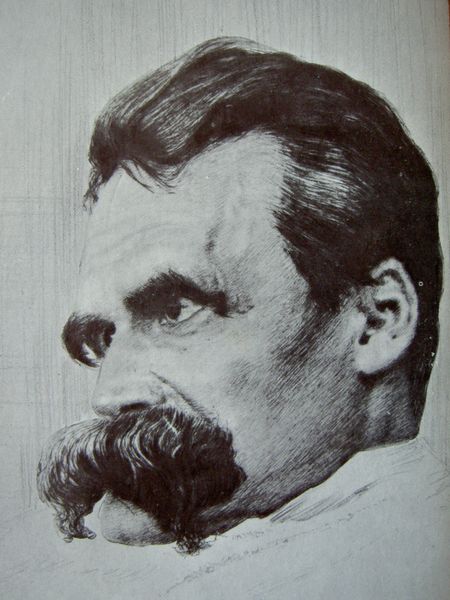
It reminds me of Nietzsche's claim that "There is no truth." 

Do you see the problem with that statement? Making a universal claim that there is no truth, is a universal claim of truth. The only difference is, his claim to truth is that it doesn't exist. However, it does exist in by saying it doesn't. 

I am not saying I am a follower of Nietzsche, nor am I saying that I believe all things can be described by language, but I think our attempts at showing our limitations funny, even ironic.


Wednesday, September 17, 2008

Race is not THE issue.

On July 11th, 2008 I wrote a post about how race is not an issue for me, and I inferred that it probably isn't an issue for most people. 

However, Obama surrogates and sympathizers have been constantly playing the race card without provocation. CNN correspondent Jack Cafferty is trying to make race out to be the biggest issue explaining closeness in the polls between Obama and McCain, negating the other more obvious reasons like: 1. the republican convention, 2. Sarah Palin, 3. McCain's appeal to moderates, 4. his 'maverick' image (and actual distance from Bush and his own party), as well as 5. his appeal to blue collar workers. The reason Obama has not surged ahead has nothing to do with his race, and A LOT to do with his skimpy record and lack of legislative accomplishments. People are just unsure if he has the experience to do the job. So let me show you what Mr. Cafferty said:

"Race is arguably the biggest issue in this election, and it's one that nobody's talking about. The differences between Barack Obama and John McCain couldn't be more well-defined. Obama wants to change Washington. McCain is part of the Washington and a part of the Bush legacy. Yet the polls remain close. Doesn't make sense...unless it's race."

First off, Cafferty makes no effort to show impartiality saying, "Obama wants to change Washington. McCain is part of Washington and a part of the Bush legacy." It may be true that Obama wants to change Washington, but so far, in his 3 years in the senate he has had zero impact. No new transformative legislation to put his name to. Not even a co-authored bill. Furthermore, Obama has only worked with republicans 17% of the time in the senate, whereas McCain has worked with democrats 55% of the time. So while Obama claims bipartisanship in theory, he has never done it in practice. McCain is a testament to bipartisanship, and that is a big part of his appeal, not because he's white. And then Cafferty says McCain is "part of Washington and a part of the Bush legacy." First off, he has been Washington for 26 years, but that is more of a boon for him than something to discredit him with, given his record that is far from the usual partisan gridlock type politics. Secondly, McCain has almost always been at odds with Bush in the places that it matters most. McCain has always been a supporter of global warming legislation, and has fought against corporate interests and large pharmaceuticals (I don't agree with his approach, but I will defend the fact that he is very UNLIKE Bush in those, and other areas like government spending - Obama is actually more like Bush in that regard, wanting to spend more)

So, with all of that, somehow race is supposedly rearing its ugly head. The fact is, it is not, but the democrats so desperately want it to be, they make comments like Cafferty's and Time Magazine's Michael Grunwald who says race is the elephant in the room, even suggesting Barack Obama needs to tread lightly as he fights back against the McCain-Palin attacks. Of course he makes little mention of Obama's attacks, which have not been any better, and in fact, are terribly misleading like his recent Spanish language ad attempting to link McCain with his long time nemesis Rush Limbaugh (and misquoting Limbaugh in the process). Not only that, but Obama once again is using the race card to scare voters, just as when he claimed earlier in his campaign as he had secured the nomination, McCain would use the race card against him. So far Obama has used the race card twice (and many more times if you count all the media correspondents who back him) and McCain hasn't used it once. So is Obama really being hurt by his race, or is he using it as a fear tactic to gain voters worried about being labeled as bigots and racists?

Oh, and another one who wants to make this election a race war is Gov. Sebelius of Kansas (D). Read here for her comments.

My opinion? Let's clean this up folks. Get back to the issues, like Obama said (oh, and Senator Obama, you might want try it yourself).

Monday, July 21, 2008

CHOW! Tchau! Ciao!

Here is a similar word in three languages:

tchau
ciao
chow

The first is like saying 'goodbye' in portuguese, although they also say 'adeus' for longer goodbyes. The second is saying 'goodbye' in Italian, and of course they have a similar phrase in italian for longer goodbyes.  Most of you will be familiar with the third.  Chow in english is either something you feed your dog, something you do, or a name of a Chinese friend.  So the similarities stick with the latin-based languages, but the germanic english is on its own.  Oh english, you're so silly.  You're the non-conformist of the european community. Thank goodness.

Friday, June 20, 2008

English Diction


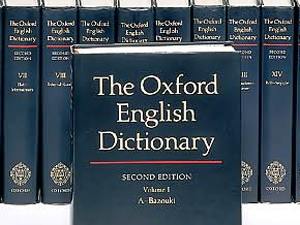
We as Americans, users of the english language, perhaps too often take it for granted. Some of us think of it as a slut or a mongrel because it adopts so many foreign words. Some might think it lazy not to come up with some words of its own. However, whether you like it or not, english is what we speak. It's true that it adopts a lot of words, but over 4,000 new words and uses are added to the Oxford English Dictionary every year. So while it may seem slutty, it gets the job done.

Here are some examples of adopted words: croissant, bureau, lasagna, schmuck, and garage

Some people deliberately anglicize many of these words, but in the instance with bureau and garage, it becomes difficult to do without getting strange looks from people. So here's a different take on the english language: It's flexible, versatile, and it is fairly easy to become conversational in it. Now, I don't believe it's easy to speak and write correctly (to be contrary to the thoughts of so many people), but you can learn it well enough, in a short enough period of time, to function efficiently in an english-speaking country.

Saturday, June 7, 2008

You Saucy Meatball

Along the lines of spaghetti and Italian pasta, some of my buddies and I have a different language interaction than most of you. For instance I might call my friend a saucy meatball, a meat sack or something. Some might find it strange, but that's only because they don't understand or are jealous. I've found that men in general have lots of inside jokes and even have covert languages among friends. My friends and I are no exception. For the longest time, a couple buddies from High School and I used the word 'icecream' to signify something. Let me give an example:

"Dang man, that's some sweet ICECREAM over there."

So, yes it was a good thing. Now here's another interaction:

"Hey meatball, we going to the gym?"

Response: "I'm already here meatsack."

And another for you:

"Dude, he's a poacher."

Taken at face value, these little phrases are, for lack of a better word, retarded. Or, perhaps nonsensical. But at any rate they mean something. And that something is far more important than the phrase itself. It is generally coupled with winks, nodds, neck jerks, grunts or angry stares. This way, women are left confused and stay out of the loop. And, even when you think it'd be nice for them to be in the loop, they can't get in even with some subtle hints. For guys, less is more with communication. With girls, more, more, more.